
The old tech cliché still arrives wearing the same costume: young founder, glowing laptop, apartment with questionable furniture, grand plans to “disrupt” something before lunch. It is a durable little myth, but it leaves out a growing part of the real story.
Across the country, professionals in their 50s and 60s are moving into freelance coding, web development, app work, and software consulting. Some are coming from corporate jobs. Some from teaching, operations, health care, marketing, finance, small business, or nonprofit work. Many are not trying to become startup celebrities. They are trying to build something more useful: an independent career that turns experience into income, with code as the tool that makes it possible. That broader shift sits inside a larger labor-market reality: older workers are already more likely than younger workers to be self-employed, and skilled freelance work is now a major part of the U.S. economy.
That makes this moment interesting. The move into freelance coding later in life is not just a story about reinvention. It is also a story about leverage. A former operations manager who learns automation is not starting from zero. A nurse or clinic administrator who begins building intake tools already understands the daily chaos those tools need to solve. A longtime consultant who starts creating dashboards or client portals is not guessing at user needs from a whiteboard in a trendy fog. They know where the friction lives, because they have been tripping over it for years.
And that, it turns out, matters more than the mythology suggests.
Research published by the American Economic Association found that the mean founder age for the fastest-growing new ventures is 45, not 25. Even more important, prior experience in the specific industry strongly predicts entrepreneurial success. The lesson is not that age automatically makes people better founders or better freelancers. It is that experience, especially experience tied to a real market, can be a serious commercial advantage. In tech, where the public story often worships youth, the quieter truth is that domain knowledge tends to age very well.
The labor data backs up the idea that this is more than a niche curiosity. AARP’s analysis of 2023 Bureau of Labor Statistics data found that self-employment rates rise with age: 8.9% for workers ages 25 to 49, 12.9% for workers ages 50 to 64, and 23.5% for workers 65 and older. In plain terms, older adults are already the age group most likely to work for themselves. That does not mean all of them are coding, of course. But it does mean the independent-work model is already much more common among older workers than many people assume.
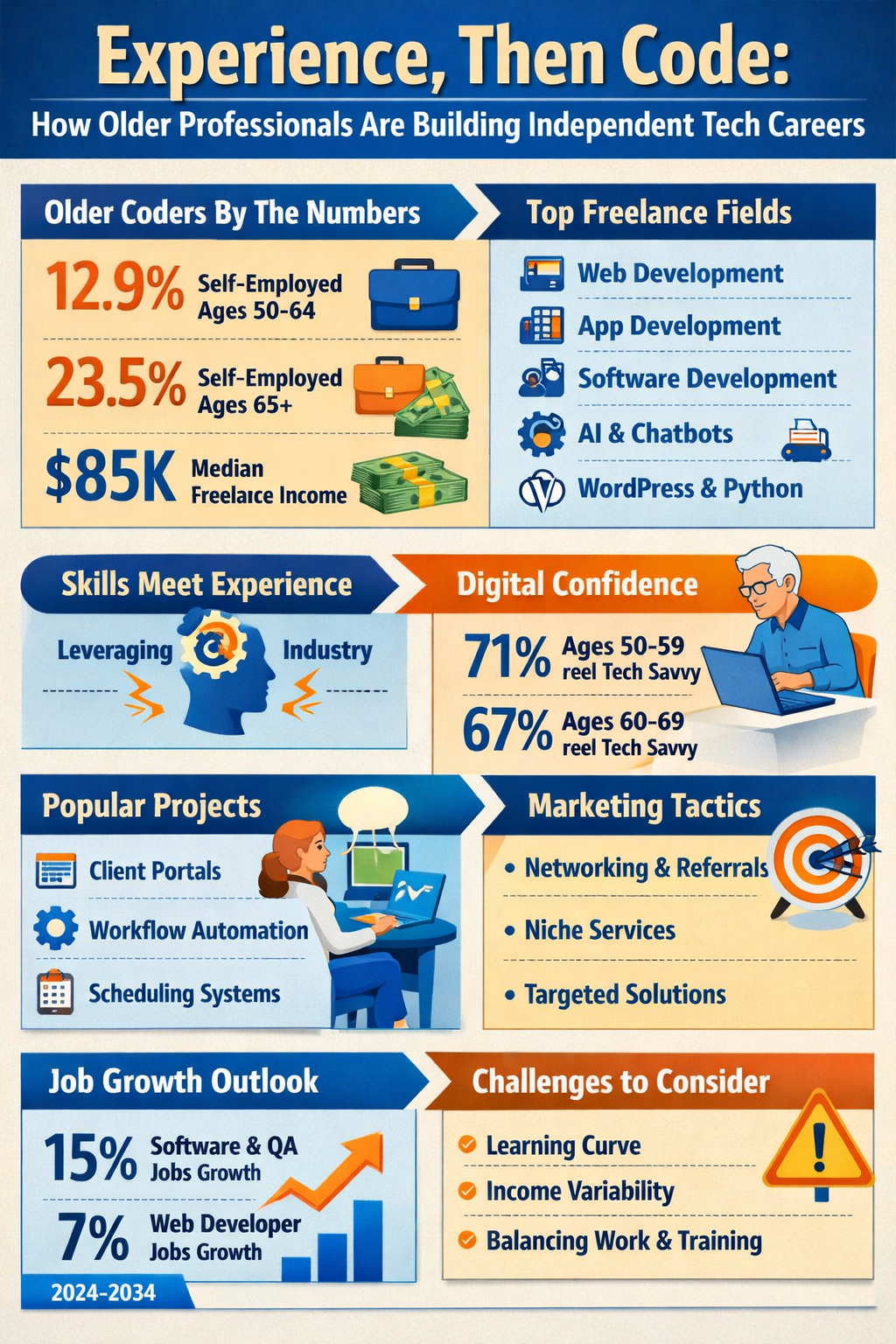
At the same time, freelance knowledge work has become too large to dismiss as side-hustle scenery. Upwork’s 2025 Future Workforce Index found that 28% of skilled knowledge workers now operate in freelance or other nontraditional work models. The report says roughly 20 million U.S. workers performed skilled freelance knowledge work in 2024, generating more than $1.5 trillion in earnings. Across fields including writing, design, and IT and development, full-time freelancers reported median income of $85,000. Those numbers are survey-based market indicators, not a census of older coders, but they make one thing very clear: the infrastructure for independent professional work is no longer experimental. It is already here, humming along like a giant invisible coworking space with invoices.
One reason this shift is viable is that older adults are more digitally capable than lazy stereotypes suggest. AARP’s 2025 technology trends research found that 64% of adults 50 and older say they have the digital skills necessary to fully take advantage of being online. That rises to 71% among adults ages 50 to 59 and 67% among adults ages 60 to 69. This is not a picture of a generation locked out of modern tools. It is a picture of millions of adults who are already online, already adapting, and often ready to learn more if the payoff is clear.
That said, the path is not frictionless. AARP has also reported that many older workers want to keep building their skills, while access to training remains uneven. In other words, interest is there, but support systems often lag behind. That gap matters. Moving into freelance coding at 55 or 62 usually does not work as a cinematic “start over from scratch” fantasy. It works better as a practical pivot: learn enough technical skill to build, customize, automate, and deliver solutions in a domain you already understand. That is a very different story from the usual beginner-tech narrative, and a much more believable one.
So what do these second-act tech professionals actually build?
Usually, not the next social empire. Usually, something better.

They build websites for small businesses that have outgrown templates and guesswork. They build internal dashboards for teams drowning in spreadsheets. They create scheduling systems, client portals, intake forms, membership tools, reporting automations, lightweight mobile apps, and AI-assisted workflows that save people hours of repetitive work. They build software with a job to do. In the freelance market, those lanes are visible in categories like web development, mobile app development, Python, software development, WordPress, AI app development, and chatbot development. That kind of work also sits inside a healthy demand environment: the Bureau of Labor Statistics projects software developer, QA analyst, and tester jobs to grow 15% from 2024 to 2034, and web developer and digital designer jobs to grow 7% over the same period.
This is where older professionals often gain a genuine edge. They may be newer to certain tools, but they are rarely new to business problems. A younger freelancer might advertise “full-stack development” and hope someone bites. A former logistics lead can say, “I build dispatch and scheduling tools for service businesses.” A former educator can build learning platforms for tutors, trainers, or nonprofits. A longtime finance professional can create reporting automations for small firms that cannot afford enterprise software. In other words, older freelancers often market solved problems, not just technical ingredients. Clients tend to notice the difference.
That is why experience matters so much in this lane. The code is important, but the business judgment around the code is often what wins the work. Knowing which feature does not matter can be as valuable as knowing how to build the one that does. Understanding how clients buy, stall, panic, and prioritize can be as important as understanding a framework. The software can be learned. So can the freelance mechanics. What is much harder to fake is the judgment that comes from years spent inside real workflows, with real consequences, among real people who do not care about elegant architecture unless it saves time or makes money.
Marketing in this world looks different from the loud, brand-heavy version often associated with startups. For many older freelance coders, marketing is really a blend of credibility, referrals, and specificity. The first clients may come from former colleagues, prior industries, or professional networks built over decades. The pitch is usually strongest when it is narrow and concrete: I build intake systems for clinics. I create custom dashboards for operations teams. I automate reporting for consultants. Generic freelance branding tends to dissolve into wallpaper. Niche positioning, on the other hand, tells clients why you, why now, and why this problem.
Digital platforms still matter. MBO Partners’ 2025 State of Independence found that 42% of independents rely on digital platforms to find work, while 32% now serve global clients. The report also found that 63% say independence is fully by choice, 67% feel more secure, and 74% use AI, with 61% saying it saves time and increases output. Those figures help explain why freelance tech work has become more appealing across age groups: the independent path now comes with better tooling, broader reach, and more ways for a solo professional to operate like a tiny, focused agency instead of a lone generalist paddling upstream with a broken oar.
Still, this is not a fairy tale with a GitHub repo.
Freelance coding can be unstable. Rates vary. Technical learning takes time. Client work demands communication, sales discipline, and project management, which are separate muscles from coding itself. Not every older professional who studies development will build a thriving independent business. Some will decide they prefer employment. Some will use coding as a complement to consulting or teaching rather than as a full-time freelance identity. Some will discover that what they really want is not to become “a developer,” but to become more capable, more autonomous, and more valuable in the work they already do.
That may be the most useful way to understand the trend. For many older professionals, coding is not about trying to become younger or imitate startup culture. It is about becoming more independent. It is about taking decades of accumulated judgment and pairing it with digital tools that can package, automate, or scale that judgment into useful services and products. The work may look modern, but the advantage underneath it is often old-fashioned: experience, patience, credibility, and an understanding of what people actually need.
The public image of tech may still skew young. But the working reality is wider than that image. More professionals over 50 are entering independent tech careers not because they fit the stereotype, but because they do not need to. They are building practical software, serving defined markets, and turning what they already know into something newly marketable. Experience comes first. Then code. And for a growing number of people, that sequence is proving to be a very workable way to build a second act.
- AARP Public Policy Institute, Older Workers and Self-Employment.
- Upwork Research Institute, The Future Workforce Index: Evolving Talent Trends in 2025 and Beyond.
- AARP, 2025 Technology Trends and Adults 50+.
- American Economic Association, Age and High-Growth Entrepreneurship.
- U.S. Bureau of Labor Statistics, Occupational Outlook Handbook: Software Developers, Quality Assurance Analysts, and Testers.
- U.S. Bureau of Labor Statistics, Occupational Outlook Handbook: Web Developers and Digital Designers.
- MBO Partners, 2025 State of Independence in America Report.